


Admin

Apr 28, 2026

Surfing
The global water sports market has reached a mature stage where success is no longer determined solely by retail marketing, but on the factory floor. For international sourcing managers, outdoor distributors, and major e-commerce brands, partnering with the right kayak manufacturing companies is the most critical logistical anchor for their business. Polyethylene watercraft are bulky, high-volume products with narrow manufacturing windows and demanding quality controls.
Identifying a truly elite supplier requires looking past glossy commercial brochures and evaluating the company’s internal production automation, tooling engineering, and supply chain capacity. A common mistake is treating all large-scale factories as equal based on their monthly output. In reality, the difference between an average factory and an elite manufacturing partner lies in their ability to maintain strict geometric tolerances, material consistency, and flawless component integration across thousands of units.
Industrial Automation and Oven Thermal Management
The foundational pillar of high-volume watercraft production is the rotational molding oven. While the chemical principles of melting polyethylene remain the same across the industry, how a manufacturing company controls the thermal environment inside the oven separates low-cost factories from world-class suppliers.
[Unoptimized Manual Oven]  ➔ Heat spikes ➔ Spot burning & localized thinning ➔ Brittle hull
[Automated Thermal Control] ➔ Continuous air adjustment ➔ Uniform melting & wall distribution ➔ High-strength hull
In an unoptimized manufacturing setup, oven temperatures are monitored manually or via basic timers. Because large aluminum molds contain varying masses of metal, different zones absorb heat at different rates. This can lead to localized overheating—where the plastic resin degrades and loses its impact resistance—or under-heating, which leaves pinholes and weak un-melted powder inside the hull.
Advanced Thermal Control Systems Used by Top Manufacturers:
-
Real-Time Internal Air Temperature (IAT) Sensors: Elite manufacturing companies insert wireless, heat-shielded telemetry sensors directly inside the rotating mold cavity. These sensors track the exact phase transitions of the polymer powder, allowing the computer to adjust burner intensity precisely when the plastic reaches its optimal melting point.
-
Variable Biaxial Speed Profiling: Instead of rotating the mold at a fixed speed, advanced CNC arms vary the ratio of horizontal and vertical rotation throughout the cycle. This ensures that complex zones, like sharp storage compartments or deep pedal-drive wells, receive an exact distribution of molten plastic.
-
Modulated Multi-Stage Burners: Modern ovens use clean-burning natural gas systems that shift smoothly between intense heating phases and lower-temperature soaking phases. This precise control prevents surface burning and guarantees a flawless surface finish on every boat.
Tooling Engineering: CNC-Machined Aluminum vs. Cast Molds
When a brand owner wants to develop a proprietary hull design through OEM or ODM channels, the choice of tooling engineering represents a major capital investment. Kayak manufacturing companies generally offer two distinct paths for mold production: cast aluminum molds or CNC-machined block aluminum molds.
| Tooling Parameter | Cast Aluminum Molds | CNC-Machined Block Molds |
| Production Method | Molten metal poured into a sand plaster matrix | Computerized milling directly from a solid billet |
| Surface Precision | Moderate ($\pm 1.5\text{ mm}$), potential for micro-porosity | Extreme ($\pm 0.1\text{ mm}$), perfectly smooth surface |
| Parting Line Quality | Requires manual grinding, prone to flash leaks | Razor-sharp alignment, minimal visible seam line |
| Long-Term Durability | Susceptible to cracking under constant thermal cycles | Highly stable, resistant to warping over thousands of runs |
The real problem is that choosing cheap cast molds to save on initial setup costs often hurts your product quality down the line. Cast molds regularly suffer from tiny surface flaws and slight structural variations. These issues make it difficult to keep the parting lines completely tight, resulting in thick, unsightly plastic seams that must be manually ground down after production.
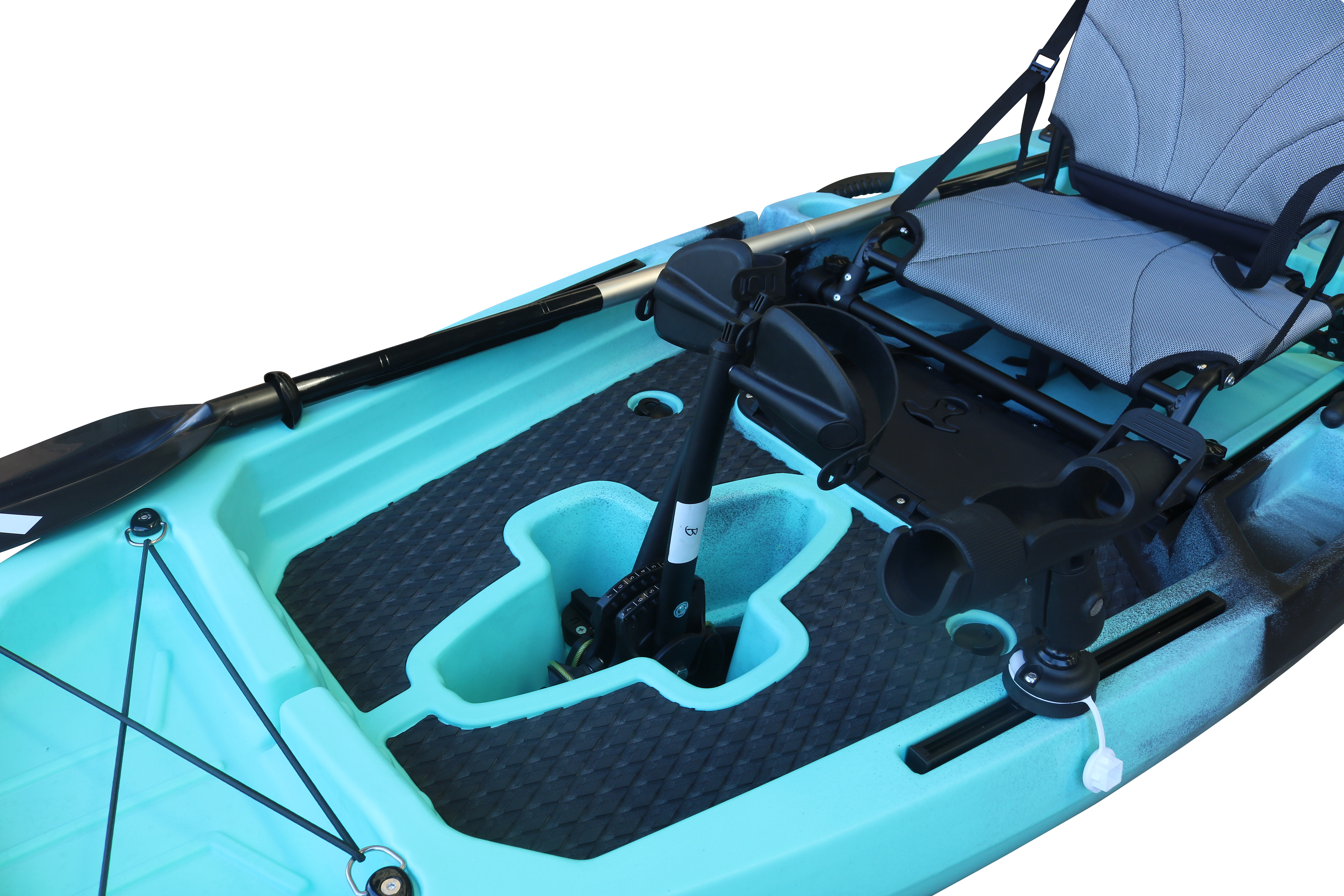
Conversely, companies that invest in premium CNC-machined tooling can create incredibly intricate features with razor-sharp precision. This allows for molded-in gear tracks, complex scupper structures, and perfectly flat mating surfaces for hatches and gaskets. This level of detail ensures that every finished boat looks flawless and fits together perfectly during final assembly.
Solid Billet Aluminum ➔ Precision 5-Axis CNC Milling ➔ Perfect Parting Lines ➔ Flawless Kayak Hull
Supply Chain Integration and Post-Molding Assembly Flow
A watercraft is not just a hollow plastic shell; it is an assembled product made up of dozens of individual components. The efficiency of a factory's post-molding assembly line directly impacts its lead times and wholesale pricing stability.
Technical Insight: The most common cause of shipping delays in the outdoor industry is not the rotomolding process itself, but bottlenecks in accessory assembly. If a factory relies on erratic third-party suppliers for its stainless steel tracks, aluminum seats, or rudder lines, the entire production schedule can grind to a halt.
To eliminate these logistical risks, the world’s best kayak manufacturing companies operate completely integrated facilities. In most cases, these factories handle aluminum tube bending, injection molding for small plastic pieces, and custom sewing for stadium seats right on site.
[Rotomolding Hull Extrusion] ───► [CNC Routing & Flash Trimming] ───► [In-House Accessory Assembly] ───► [Pressure Leak Test]
By keeping these supply lines inside the same facility, the factory can run a smooth, continuous production flow. As soon as a hull leaves the cooling bay, it moves down an automated track where specialized technicians install brass inserts, secure steering cables, and fit hatches using precise pneumatic tools. This vertical integration keeps quality high, keeps costs predictable, and guarantees steady delivery windows even during peak production seasons.
Rigorous Quality Management: Beyond the Standard Bubble Test
For B2B buyers distributing goods across international markets, product returns due to manufacturing defects can devastate profit margins. Vetting the quality assurance (QA) laboratory of a manufacturing company is just as important as inspecting its production capacity.
The safest choice is to partner with a company that implements a fully traceable, multi-tier quality control protocol. Every single hull should be stamped with a unique Hull Identification Number (HIN) that links back to a digital record. This record logs the specific resin batch used, the exact oven arm that cooked it, the operator who managed the cycle, and the final inspector's checklist.
[HIN Unique Identification Number] ───► Logs Material Batch, Oven Arm Metrics, Operator ID, & Final QA Clearance
Advanced facilities expand on basic low-pressure leak testing by performing automated wall-thickness scans using ultrasound arrays. They also run destructive lab tests on small plastic cutouts from hatch openings to analyze the material's impact resistance at low temperatures. This data-driven approach to quality control ensures that potential defects are caught and fixed on the factory floor, long before the containers are loaded for transport across the ocean.
Related Post





Hot Products - Sitemap - Special
best kayaks with pedals , sit on top canoe , kayak float , kayak suppliers , rotomolded kayak manufacturers , top kayak manufacturers
 Privacy settings