



Admin

May 01, 2026
Surfing
The commercial watercraft industry has evolved from producing simple paddle boats to manufacturing complex, high-performance vessels designed for diverse environments. For international distributors, commercial outfitters, and outdoor brands, choosing a partner from the crowded field of kayak boat manufacturers is a foundational business decision. Because these watercraft are structural safety products designed for open water, purchasing managers must look past basic color choices and low-cost offers.
A common mistake is evaluating a manufacturing plant solely by its physical size or daily output. True quality shows up in the company's mastery of fluid dynamics, automated polymer processing, and precision component assembly. When you work with an elite manufacturing company, every curve of the hull and every metal attachment point is carefully engineered to deliver reliable performance and protect your long-term business investment.
The Hydrodynamics of Hull Design: Tracking, Speed, and Drag
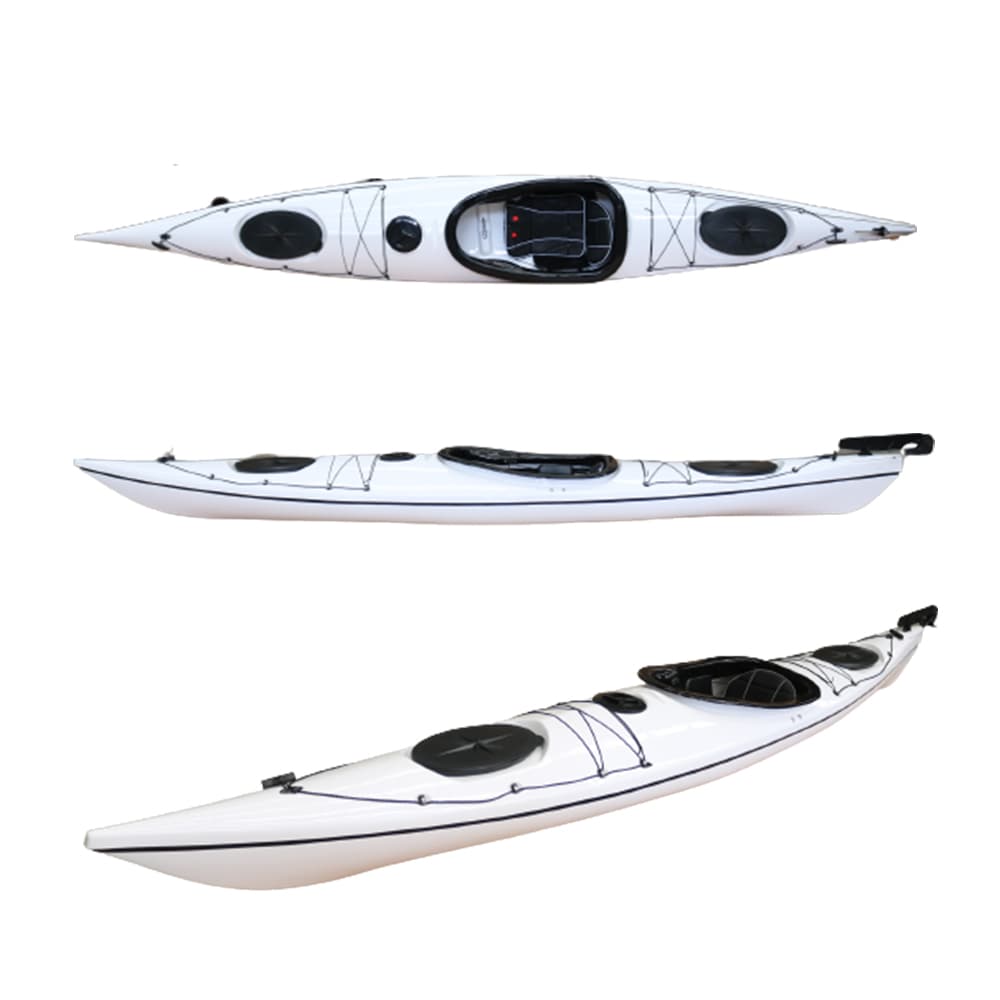
When designing a commercial kayak hull, naval architects balance several competing physical forces: skin-friction drag, wave-making resistance, and stability metrics. Elite manufacturing companies use advanced Computational Fluid Dynamics (CFD) software to simulate how a hull shapes water flow before building the physical production molds.
[Narrow Bow Entry] ──► Reduces Wave Resistance ──► Increases Cruising Speed
[Flared Mid-Section] ──► Optimizes Buoyancy ──► Maintains High Secondary Stability
[Clean Stern Exit] ──► Minimizes Hydrodynamic Eddy Drag ──► Improves Straight Tracking
Every section of a professional hull is optimized for a specific performance goal:
Critical Hull Performance Zones:
-
The Bow Entry Angle: A sharp, narrow entry cuts through chop cleanly and lowers wave resistance. This design preserves the paddler's forward energy and keeps the boat gliding smoothly.
-
The Midship Section (The Beam): This central area determines the vessel's displacement and stability. A subtle multi-chine or flat-to-round transition provides a comfortable balance of stability on flat water and smooth leaning control in rough swells.
-
The Stern Run-Out: The rear lines of the hull must allow water to flow away cleanly without creating heavy suction drag. A straight, crisp keel extension at the stern acts like a built-in fin, improving tracking without requiring a deep drop-down skeg.
Advanced Cross-Linked vs. High-Density Polyethylene Processing
The durability of a rotomolded boat depends heavily on the internal molecular structure of its plastic skin. Professional manufacturers choose their raw materials carefully based on the product's intended environment, typically choosing between linear high-density polyethylene (HDPE) and cross-linked polyethylene (XLPE).
Linear HDPE (Parallel molecular chains) ━━━━━━► Excellent recyclable properties, easy to repair
Cross-Linked XLPE (Chemical cross-bonds)  ──┬──► Extreme puncture toughness, high structural memory
                                            └──► (Requires specialized high-temperature processing)
The real problem is that processing high-grade resins requires precise control over the oven's heating cycles. While linear HDPE provides excellent impact resistance and can be easily repaired with plastic welding if damaged, XLPE creates a cross-linked network of chemical bonds during the baking cycle. This cross-linked structure gives the plastic incredible puncture toughness and structural memory.
In most cases, factories that use these advanced polymers must run longer heating cycles and utilize specialized multi-zone cooling bays. This careful process prevents internal voids and ensures the hull can handle heavy rocks and scraping across gravel shores without losing its designed shape.
Mechanical Tolerances in Propulsion and Steering Integration
The rise of hands-free pedal drives and advanced rudder steering systems has changed how manufacturers build plastic hulls. Polyethylene naturally expands and contracts during production, which makes maintaining tight mechanical tolerances a significant engineering challenge.
| Component Interface | Manufacturing Tolerance | Primary Failure Risk if Exceeded |
| Pedal Drive Well | $\pm 0.75\text{ mm}$ | Loose rattling, misaligned drive chains, hull friction |
| Internal Rudder Sleeve | $\pm 0.25\text{ mm}$ | Water leakage into the stern, stiff steering response |
| Flush Rod Holder Mounts | $\pm 1.00\text{ mm}$ | Loose accessory fit, localized plastic stress cracks |
To achieve these tight tolerances, the best kayak boat manufacturers do not cut accessory openings by hand using basic tools. Instead, they invest in automated 5-axis CNC routing robots.
[Rotomolded Hull Loaded] ──► [Laser Alignment Scan] ──► [Robotic 5-Axis CNC Cut] ──► [Perfect Accessory Fit]
Once a hull leaves the cooling bay, it is locked into a heavy steel fixture. A robotic arm scans the hull's position with a laser guide and cuts out hatch openings, scupper holes, and drive wells with extreme precision. This automated approach ensures that every pedal drive snaps in perfectly, every rubber gasket seals tightly, and your customers experience zero installation or leakage issues.
Comprehensive Hydrostatic Testing: Ensuring Absolute Buoyancy
For global B2B buyers distributing outdoor products across international markets, product safety is a top priority. A single leak in a hollow watercraft can ruin a brand's reputation and create costly liabilities.
The safest choice is to partner with a manufacturing company that treats quality control as a mandatory step for every single boat, rather than just testing random samples from the line. Elite factories pass every hull through a dedicated quality checkpoint before it moves to packaging.
[Seal Hull Openings] ──► [Inject Low-Pressure Air] ──► [Apply Soap Leak Indicator] ──► [Certify Airtight Seal]
Technicians plug every molded insert and hatch, then inject a controlled stream of low-pressure air into the hull. They spray a specialized liquid soap indicator over all seam lines, brass fittings, and drainage plugs. If even a microscopic pinhole exists, the escaping air creates a cluster of visible bubbles, allowing the team to catch and fix the issue immediately. This rigorous hydrostatic checking process ensures that every boat leaves the shipping container ready for the water.
Related Post






Hot Products - Sitemap - Special
fishing cooler box , Durable roto molded kayak supplier , rotomolded kayak manufacturers , kayak stand , kayak rack , modular kayak
 Privacy settings